

Projects Overview
The Design
Gallery

Role: Solo Developer
Team Size: 1
Game Engine: Unreal Engine 5
Project Type: Personal Project
About:
The Stone Tape Theory is a Third Person Horror Survival Shooter I created that follows a group of people called The Dreamers, with the main character named Vai.
Story:
The main antagonist, called "The First One," is an Eldritch-like entity that's been around since the collapse of civilization dating back 400 years ago after Witikos (Skin Walkers) wiped out a majority of the human race. For the last 400 years, the Dreamers have been searching for specific tapes in the hopes of finding a way to locate The First One but also reverse the process of humans turning into Witikos.
Since the event, when humans die a traumatic death their energy leaves an imprint in the earth around them, trapping their soul forever. When Dreamers interact with the imprint, they get to relive the victim's fate by going through what they went through.
Vai, the game's protagonist, is a regular Dreamer like all the others. However, they’ve been raised since they were kids to enter these tapes, but like many others, they wonder what life was like for people prior to the event...
The Design
Everything Below is me talking about the design of my game, Inspirations and explaining why certain decisions were made
System Design
Ah yes, Systems Design. The handeling of everything that interconnects at the crossroads of wish's and desires of the player. The stuff the player cant directly control. For a game like The Stone Tape Theory which is a Third Person Game. My immediate goal was the get the 3C's up and running as soon as possible since doing camera work for a game with combat takes a long time to feel great!
For those that do not know what the 3C's stands for, it stands for: Character, Camera and Controller. VERY important stuff inside a video game as a good camera is not noticed but a bad camera is. First thing i did was play games of similar types to understand what it is about them that is enjoyable and what is not enjoyable. A couple games from my list was (Dead Space 2023) Resident Evil 2,3 (2019,2020)
Camera
They all had a similar camera which is generally pulled up close and features the character off to the left side of the screen, This is to give the player more screen space to see what's in front of them but also to have good gameplay feel for horror and shooting.


However, even though all cameras look the same they aren't all the same. The Stone Tape Theory camera was different in regards to the playable space the player had available but also since my game featured sprinting and crouching, which allowed the player to move faster than the previous games mentioned. But that resulted in camera work switching based on what the player was doing.
When the character is aiming, the camera pushes forward to be closer to the player to allow for a more compressed screen space experience, better accuracy, and to restrict what's in the player's FOV to allow them to focus on what's in front of them.
When they are not aiming but instead "exploring," I push the camera out to allow them to see more of the environment since in this instance the player just killed an enemy and has no more threats they are aware of, which in result would cause more players to lower their guard and look at the environment around them. I also kept the camera movement to a minimum since I didn't want the player to get dizzy or disorientated due to a lot of camera movements such as shakes or tilts.


Controller
One of my biggest regrets with making a game of this style is not having the basic movement part of the character feel as refined as I would have liked it to. While I got it to a position of satisfaction and it is definitely playable, it could have been way better. Early on in the project I tried having 8D movement to allow the player to strafe, versus having the character rotate depending on player movement limiting it to 4D movement. Having this in felt like night and day; however, I could not find enough animations to fill the gap needed, and so I was stuck using 4D movement.
Character
Designing a character that fit the world but also contained mechanics that players found fun and intuitive to use was a fun process for this game. I already knew for the most part the player needed ranged weapons to fight the enemy, as when I did a playtest of The Callisto Protocol I found being forced to solely use melee for large parts of sections got tiring for me. For games like this I always believed ranged combat was the pillar since a lot of the horror comes from enemies chasing the player and the player wanting to be as far away as possible from the enemies and not forced to run towards them.
I also knew I had to provide the player with more than one single way to defend themselves. As I said in the previous paragraph, using a single weapon for such a large part of the game would get boring. While giving the player a new weapon in most instances switches up gameplay, I also wanted to use the presence of more weapons as a reward for the player for getting further into the map.
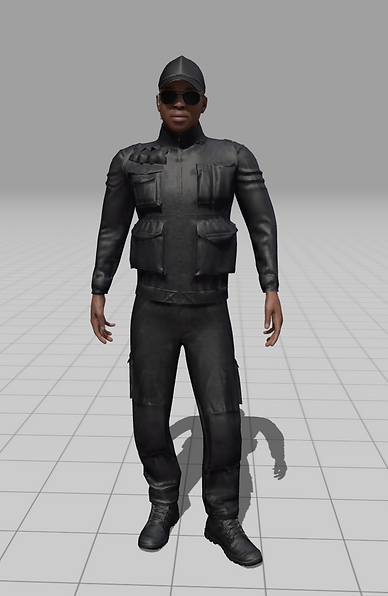

However the character part of the 3C's is more than just the visual or narrative elements of the Player Character, it's about the limits of the capacity of which they can use the mechanics they have available to them. How far can one run? How far does the player move when winding up a slash attack?
To answer similar questions I created a metric level where I spent most of my time during the 3C era for my game. Inside this metric area I created, tested, and iterated every single one of the player’s mechanics. Some took significantly longer than others; however, it was time well spent. Below you will find some pictures of my metric room early on. It contains stuff such as the metrics for doors the player can walk through, spaces they could crouch through (when it was in the game).
This section also contains the area I called "The Light Room," a section of the metric level solely for the purpose of refining the player’s flashlight. This room contained the lowest possible light levels I would add into the game, and from that I tuned the flashlight to work in those conditions. I took the system design approach of tuning something to the highest possible number it could be and working back from there until you got the sweet spot.


Flashlight
The flashlight, which in most games is a simple tool for the player to have, usually just illuminates areas when shined in that direction. My flashlight serves two purposes.
Not only does it light up pathways for the player, but it also acts as a secondary way to indicate the player’s health. It has three levels, each changing the color of the flashlight from white to light red to dark—corresponding roughly to 100-70% HP, 70-40% HP, and 40-30% HP respectively.
This was my attempt at creating something new or innovating on a very commonly used mechanic.


Combat
I wanted a combat system that allows both ends of player skill to be able to finish the game, so I accounted for those that may be new to the genre or hardcore veterans. The way I did this was I added a "Stun" to every first damage instance an enemy could receive from the player. Whether that be attacking the enemy with a knife, the pistol, or the assault rifle. They all get mildly stunned for a brief period. However, any damage afterwards doesn't stun them again and they will chase the player indefinitely until the player or the enemy dies.
Having this in allowed both skillsets to be successful but also challenge should they not kill the enemy during the stun period. A skillful player will easily be able to line up a second headshot killing the enemy easily rewarding them for having such high accuracy, while those not so accurate still have a similar attempt to kill the enemy.
Regardless of skillsets both players are challenged should they mess up.

Level Design
Level
2 playable characters in 2 different worlds means 2 different levels, so I decided to break up the first world to be a more tutorial area for basic player movement and interactions and save actions such as combat, healing etc. later down the level. I separated what I wanted to teach the player since when they first entered the level I wanted them to be absorbed by the atmosphere and not worried about "How do I move?" "How do I grab things?". When ideally they don't need to know shooting until it's relevant.
I always start out with a paper map or a digital map, both allow me to quickly draw a mockup of the map before jumping into engine since it's easier to make changes on paper rather than in engine, (I also do this for my User Interface) After getting feedback from the team if it's a group project I then go into white boxing which consists of 2 phases.
Phase 1 contains a rough outline of the size map intended for the player made in engine using Unreal Engine's Modelling Tool or Unity's Pro Builder Tool, The purpose of this white box for me is to gauge just how big we want the map to be, this phase may take longer depending on whether the game is Third Person and depending what type of mechanics the player has to navigate the space. for example if the game is third person like The Stone Tape Theory, you may need more space to accommodate the player camera.
*Playtest happens*
Phase 2 consists of me doing a pass-through of stub placement (usually 3D text or models) that fill the space to showcase where enemy encounters happen, important locations the player has to go to etc. (I also add the Mario Rule during this phase)
*Playtest happens*
After all of these are done I then proceed to refine and continuously playtest people through it since at any step during white boxing, objects and encounters in level feel drastically different than on paper.
Throughout the level I also utilize the Mario rule or the Super Meat Boy rule such as introduce a mechanic in a safe space, then have the player progress out of the space with it, then escalate and then challenge them with it. I am going to use the "Break Board" mechanic to showcase this. In picture 1 I introduce it in a safe space but also make it so they have to use it to progress out of the room they are in. Then I escalate the mechanic by combining it inside a dark lit corner right before the first enemy encounter. Then proceeding to challenge the player with it by placing a door switch behind the Break Board mechanic with enemies surrounding it.
I do this many times involving things such as enemies, pickups, interactables and even respawn points when they were in the game.


Atmosphere
In a horror game atmosphere and sound design are incredibly important, when I had a group of people playtest my game they all had said one thing in common: "The Atmosphere is great!" which of course made me really happy since I spent a lot of time in it. I went for a "dirty and darker" color palette as it fits the game more appropriately. So colors like brown, black, different shades of green along with a dirty yellow REALLY made the scene stand out. I only used bright colors when I wanted to catch the player's attention to something such as the Soul Tape at the end of the level or the red switch midway through the game or even the unique document room.

